
Learn how to choose the ideal forage cultivar for your farm based on soil, drainage, drought risk, management system, and production strategy. A practical technical guide from SGM Seeds.
Choosing the right cultivar defines pasture success for years
In tropical livestock production, few decisions are as strategic as choosing the forage species and cultivar. Unlike annual crops, where adjustments can be made every season, a poorly selected pasture can compromise farm performance for 5 to 15 years.
That is why this decision must not be based on trends, neighbors’ opinions, social media hype, or generic catalog data. It must be technical, contextualized, and aligned with the reality of each farm.
SGM Seeds’ Technical Note 29 addresses this topic in depth and presents five key criteria that guide the correct choice of forage cultivars for different production systems.
Rule #1: Soil Drainage and Moisture
“Where water stays, the pasture changes.” — Don Germano
Essential diagnosis
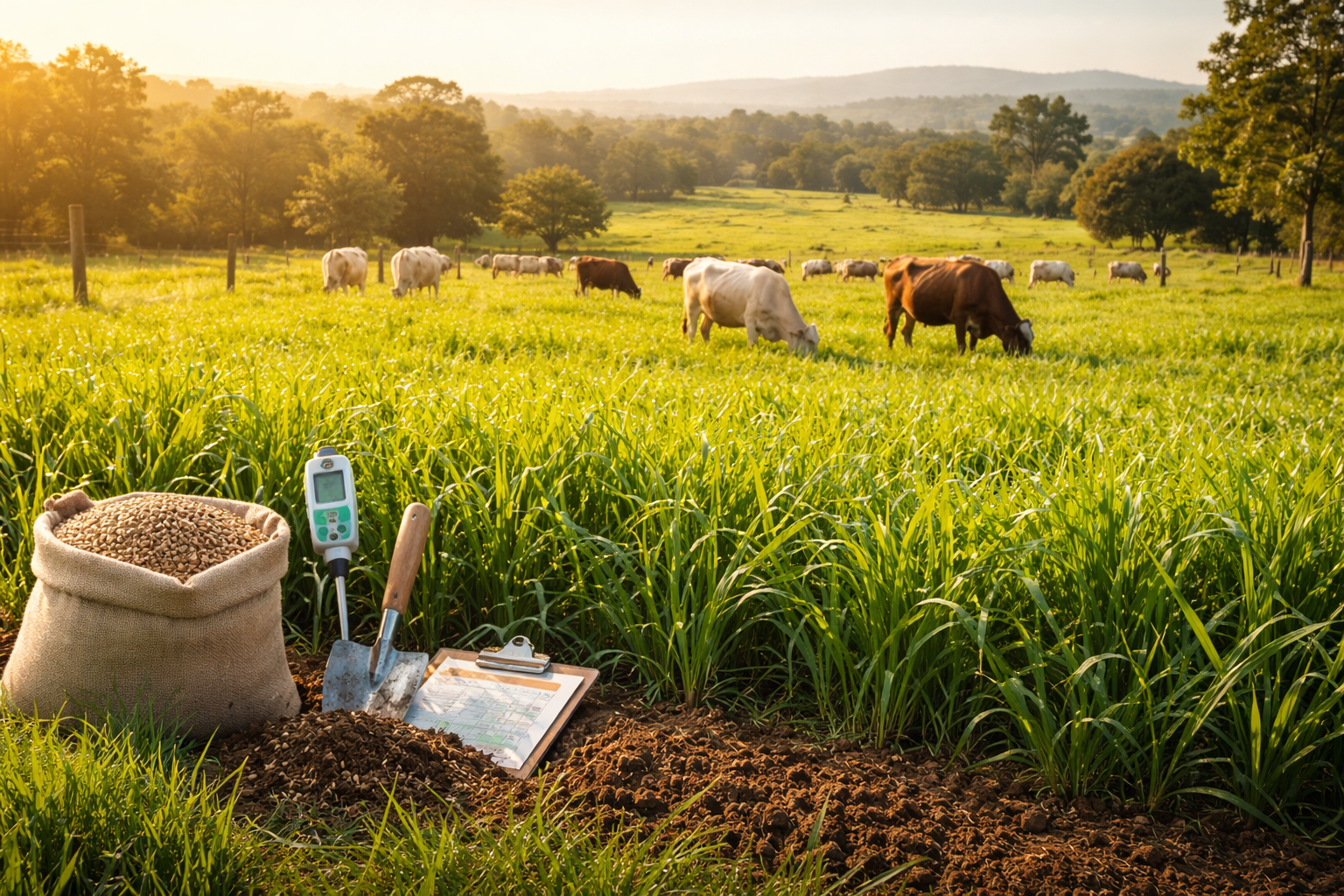
Before making any decision, it is crucial to evaluate:
-
How long water remains after heavy rainfall
-
Areas that stay waterlogged for more than 12–24 hours
-
Soil type (clay, loam, sandy)
-
History of root rot or fungal issues
-
Presence of compacted layers or shallow water tables
Technical interpretation
-
Brachiaria humidicola (Humidicola / Llanero):
The only forage truly tolerant to prolonged waterlogging. Ideal for lowlands and wet soils. -
Brachiaria brizantha (Marandu, Xaraés, Piatã, MG-5):
Good drought tolerance but does not tolerate waterlogged soils. -
Brachiaria decumbens:
Tolerates moderate drainage but not flooded areas. -
Panicum maximum (Mombasa, Tamani, Massai, Zuri, Kenya):
Requires excellent drainage; poorly drained soils cause tiller mortality.
Practical conclusion
👉 The soil chooses the pasture — not the other way around.
Rule #2: Slope, Erosion, and Soil Protection
“On slopes, the winner is the pasture that covers the soil.” — Don Germano
Evaluation points
-
Degree of slope
-
Signs of erosion (rills, gullies, exposed soil)
-
History of soil loss
-
Previous land management
Recommendations by forage group
-
Decumbens and Ruziziensis:
Excellent soil cover, ideal for slopes and fragile areas. -
Brizantha cultivars:
Good soil coverage, suitable for moderate slopes. -
Panicum:
High biomass production but slower ground cover; not recommended for steep slopes.
Practical conclusion
👉 Protect the soil first; then think about stocking rate.
Rule #3: Water Availability and Drought Risk
“Good seed emerges; good pasture endures.” — Don Germano
Climate diagnosis
-
Annual rainfall amount and distribution
-
Length of the dry season
-
Frequency of dry spells
-
Altitude and average temperature
Drought tolerance
-
Brizantha cultivars (Marandu, MG-5, Piatã, Paiaguás):
High drought resilience; widely used across Latin America. -
Decumbens:
Extremely tolerant to water stress. -
Panicum:
High production potential but higher risk in dry regions. -
Humidicola:
Survives drought well, with lower productivity.
Practical conclusion
👉 There is no miracle pasture. Choices must respect real climate conditions.
Rule #4: Grazing Intensity and Stocking Rate
“The pasture must withstand the management you actually apply.” — Don Germano
Be honest in your assessment
-
Grazing system (continuous, rotational, intensive)
-
Type of animals (cow-calf, growing, finishing, dairy)
-
Production goals
-
Fertilization capacity
-
Available labor
Technical recommendations
-
Panicum:
Ideal for intensive systems; requires strict management and fertilization. -
Brizantha cultivars:
Versatile, stable, and reliable. -
Decumbens:
Excellent cost-benefit ratio and high rusticity. -
Humidicola:
Base pasture for difficult areas and extensive systems.
Practical conclusion
👉 Choose the pasture for the management you practice — not the one you wish to practice.
Rule #5: Farm Strategy
“The pasture must serve the farm’s project.” — Don Germano
Key questions
-
Cow-calf, growing, finishing, dairy, or CLI?
-
Is intensification planned?
-
Is there a fertility budget?
-
Will mechanization be used?
Clear guidelines
-
Intensive finishing: Panicum
-
Extensive cow-calf systems: Humidicola or Decumbens
-
Growing and full-cycle systems: Brizantha cultivars
-
Crop–Livestock Integration (CLI): Panicum, Ruziziensis, or Piatã
-
High-fertility soils: Panicum excels
-
Medium to low fertility soils: Brizantha and Decumbens
Practical Summary: Don Germano’s Decision Matrix
| Condition | Best forage group | Notes |
|---|---|---|
| Waterlogged soil | Humidicola | Only truly adapted option |
| Steep slopes | Decumbens / Ruziziensis | Excellent soil cover |
| High drought risk | Brizantha / Decumbens | Greater resilience |
| Limited fertilization | Brizantha / Decumbens | Low maintenance |
| High intensification | Panicum | Requires strict management |
| CLI systems | Panicum / Brizantha | Strong response to fertility |
| Extensive cow-calf | Humidicola / Decumbens | Low-cost option |
Choosing Well Means Producing Better for Years
Selecting the right forage cultivar is not an isolated decision — it is a long-term strategy. When soil, climate, management, and production goals are aligned, the result is higher productivity, stability, and profitability.
SGM Seeds — Those who know us, choose us.