














Nós usamos cookies
Este site usa cookies para aprimorar sua experiência de navegação.

Learn why the first 90 days are critical for pasture success. Discover the invisible mistakes that compromise pasture establishment and how to avoid them from the very beginning.
Many pasture problems do not start with drought or grazing management, but rather during the first 90 days after sowing — a critical period that is still underestimated by many producers.
It is during this initial phase that the productive foundation of the pasture is built. When something goes wrong at this stage, the impact follows the area for many years, affecting productivity, longevity, and overall profitability.
In many cases, the pasture emerges, turns green, and gives the impression that it has “established well.”
However, a closer look often reveals clear warning signs, such as:
uneven canopy closure;
stand gaps;
weak, shallow plants with low vigor.
This scenario creates a false perception of success, when in reality the pasture is already compromised, and the consequences appear months later.
Forage seeds are small and must be placed shallow in the soil.
When buried too deeply, emergence drops drastically — especially in Panicum cultivars, which are more sensitive to this mistake.
Without close contact between the seed and the soil, germination becomes slow, uneven, and irregular, even when there is adequate soil moisture.
Light compaction helps ensure:
efficient water absorption;
uniform emergence;
better initial root anchorage.
Weeds emerge faster than forage grasses.
When control is not performed early and effectively, the pasture loses the competition in the first few days, compromising establishment.
This often leads to:
sparse stands;
higher future weed infestation;
increased long-term management costs.
Old seeds, poorly stored lots, or non-certified material reduce:
initial vigor;
stand uniformity;
pasture longevity.
Although seeds represent a small portion of total costs, they are the input that most influences establishment success.
Failures during establishment create consequences that remain for years, including:
reduced carrying capacity;
increased weed infestation;
higher risk of early degradation;
earlier need for pasture renovation;
direct loss of profitability.
A poorly established pasture rarely corrects itself over time.
Productive and long-lasting pastures share key characteristics:
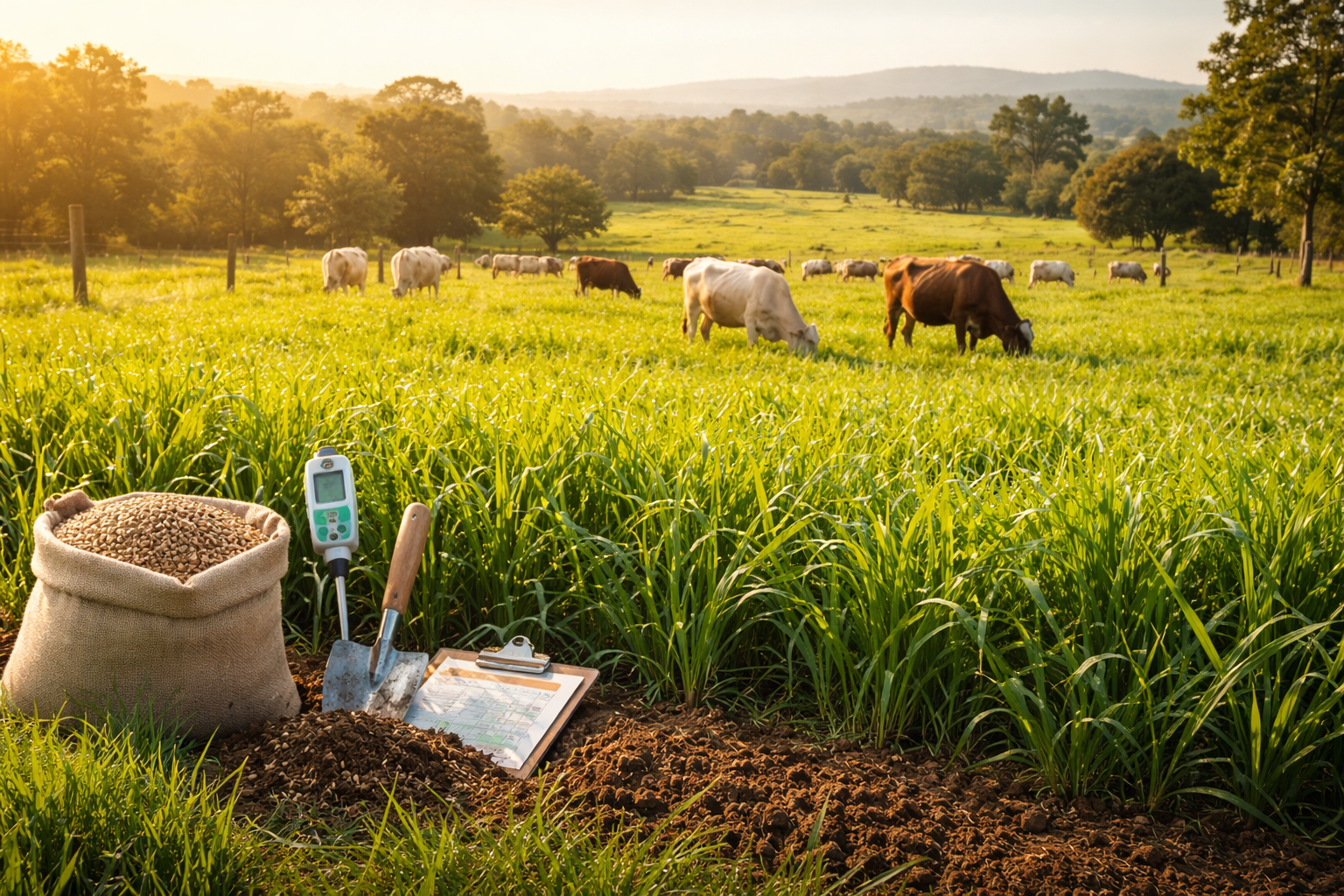
well-analyzed and corrected soil;
use of certified, high-vigor seeds;
shallow and well-distributed sowing;
light compaction after planting;
technical monitoring during the first 30 to 90 days.
This initial period accounts for approximately 80% of pasture success.
Pasture success does not begin with grazing.
It begins before the seed touches the soil and is consolidated in the first months after establishment.
Paying close technical attention during this stage is what separates durable, productive pastures from problematic areas with high future costs.
At SGM Seeds, we believe sustainable productivity is built through well-executed details, the right seed, and proper management from day one.
SGM Seeds — Those who know, choose.
Among the available options, Ruziziensis (Urochloa ruziziensis) and Piatã (Urochloa brizantha cv. BRS Piatã) stand out…
Continue readingEste site usa cookies para aprimorar sua experiência de navegação.